top of page

A Fragile Balance

Anonymous

March 19, 2025

A Fragile Balance

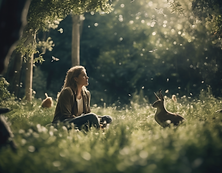
This image was generated with Dream Studio AI.

In the year 2040, the world had transformed in ways both hopeful and uncertain. Cities now thrived as green, interconnected hubs, their skyline dotted with sleek, solar-powered vehicles that hovered above the streets. Public transport, once overcrowded and polluting, had been replaced by autonomous electric pods, moving people swiftly through airways and tunnels, reducing congestion and emissions. The once-imposing traffic jams were a thing of the past.

Yet, as humanity reveled in its advancements, the Earth was also telling its story—a story of recovery and fragility. Nature, scarred by decades of climate chaos, had begun to heal, but not without difficulty. Vast forests, once endangered, were now flourishing thanks to restored ecosystems and rewilding projects. Cities had reclaimed their green spaces, integrating vertical gardens, green rooftops, and urban farms. These innovations, born out of necessity, had become a symbol of hope for the planet.

But the scars of past negligence lingered. Weather patterns had become unpredictable, and natural disasters, while less frequent, still struck with unrelenting power. A warning bell echoed in the back of people's minds—how much time was left before the tipping point came?

On the global level, nations had united in an unprecedented alliance, working toward a common goal: food security and environmental stability. Vertical farming, once a novel idea, had become the norm. Skyscrapers in every major city were now home to expansive farms that grew everything from grains to vegetables, using less water and land than traditional methods. The Earth’s soil had been treated with respect, and sustainable farming practices had revived once barren fields. It was a revolution in agriculture—one that seemed to promise a future free from hunger.
Yet, even as the world seemed to bloom, there were whispers of concern. Some wondered whether the changes were enough. Could technology truly fix everything? Could humans repair the damage of centuries in just a few short decades? It was unclear, but what was certain was that the path forward was one of careful balance—an ongoing dance between progress and preservation.

The future, both hopeful and wary, was a world of resilience, powered by innovation and a deep connection to nature. But the greatest question remained: Would humanity sustain the fragile balance they had fought so hard to build? Only time would tell.

related stories
hallo
bojan.balaban2@gmail.com
I sit in my garden and breathe clean, scented air.In my sight is a forest and in it a multitude of animals.No private cars,only public transport.Everything is socially owned:my house,the company where I work,health,school... Every household has a dog, cat or some other domestic animal that it takes care of.Human rights are at a very high level and all are respected.At work it is allowed to come with pets.By winter I heat myself on electric heaters, and electricity is not expensive because it arises only from renewable energy sources.My city is full of parks where trees are not cut down because it is rotten. but when it is dried or wilted. The branches of the trees are not cut and circumcised and therefore the movement of people is restricted.
hallo
mtrumpickaite@gmail.com
Europe and the world are currently experiencing political tensions caused by several ill-equipped leaders. The Russian president's war in Ukraine makes people feel fearful, and the American president's speeches are just worthy of the title of comedian. These inadequate people rule a large part of humanity, causing chaos, fear and confusion. If the political situation changes, we can continue to live in peace and tranquility without fear of a possible war. Such a future, and I hope that we will live in peace, without fear, and that the government will be represented by intelligent leaders. Utopian society, in which there is no place for corruption, lies, anger, greed, should be an aspiration.
hallo
kari.porttila@gmail.com
In 2030, there was a war in Europe involving the use of tactical nuclear weapons in a restricted area. As a result of the war, dozens of cities were destroyed, and nuclear pollution spread to the territories of warring parties and neutral countries under the influence of winds, causing a large number of civilian casualties. As the consequences became widely known throughout the world, the demand for a total ban on nuclear weapons arose. This led, especially in the nuclear powers, to the fall of governments and, in a few years, to the deactivation of nuclear weapons everywhere. In 2040, atomic power was harnessed exclusively for civilian use - mainly for the production of energy and heat. The main focus is on local small-scale power plants, whose patent rights are freely available to all countries. Fossil energy use has decreased significantly: or in very sparsely populated areas, it remains the most advantageous option overall. Even the smog that plagued China's big cities has practically disappeared. At the same time, green construction in urban areas has taken over the sector in almost every part of the world. The roofs of the apartment buildings are like gardens. The use of geothermal heat has become more common, while fields and forest squares covered with solar panels have been restored to their natural state. Wind farms are set up either at sea or further away from settlements, although higher installation and energy transmission costs cause critical debate.
hallo
denisgrnt@yahoo.ie
Here we are in 2040 I am now 83 years young and glad to be here the changes I have seen since times gone by are unleavable and let me explain some of them to you now. The government we now have work for the people and not themselves the wages now meet the cost of living needs, the fuel of petrol and diesel are now like gold dust to buy but the cars that run on these fuels now are nearly extinct and cost more than our EVs to buy now. Cleaner environment for us all to live in. The housing market is better now more houses are being built and at affordable costs not much poverty about at these times and we should thank god for that. Now some of the downfalls of this era are computers they control everything now we shop online now no more going to the supermarket the times of our local pubs are gone we are controlled by robots and AI this for me is hard to take I miss some of the old times open fires snow fall good summers and lots more are our times changing for better our worse YOU TELL ME.
Join #OurFutures now!

The future is shaped by our ideas and our actions today. Tell us about your visions of the future and help us create a futures narrative aimed at inspiring citizens, policy-makers and foresight experts alike!

OURfutures.png

The European Commission support does not constitute endorsement of the contents which reflects the views only of the authors, and the Commission cannot be held responsible for any use which may be made of the information contained.

ERA_logo.jpg

We support the European Research Area aimed at creating a single, borderless market for research, innovation and technology in the EU.

©OurFutures 2025, All rights reserved.

  • Instagram
  • Facebook
  • LinkedIn
  • YouTube
bottom of page