top of page

EUARENAS City of the Future

Anonymous

February 11, 2025

EUARENAS City of the Future

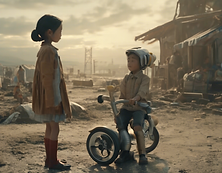
This image was generated with Dream Studio AI.

The City is based on liberating structures that are not only visible in the City’s built environment but also within the relationships between people, organisations and institutions.

At the heart of the City is a sprawling park. This landscape is a hive of activity. Crafted between the trees is sheltered learning space. A University Professor is delivering a talk on the opportunities and threats of artificial intelligence. The learners are working together with the Professor to decide how they share and use this knowledge. Nearby, people have gathered in the outdoor community cinema space watching an animated fictional film about an Autistic child who goes on an adventure to a new City. By the side of the river, a bandstand is housing musical performances from newcomers to the City - the sounds filter through the surroundings.

From the park, nature flows through the City - connecting and running through the districts that create the City’s ecosystem. Elsewhere, on a piece of wasteland, politicians and civil service staff are sat in a circle on seats fashioned from the tyres and breeze blocks that have been dumped on the land. They are discussing what to do with the land. Some residents feel it needs to be used for new, affordable, well-insulated housing with solar panels and heat pumps. Others feel it should be a communal allotment for the existing residents. An architect is listening and drawing sketches of these ideas. They are working out ways to combine them. Further down the pathway, a playground has been built using recycled materials. Each piece of equipment needs at least two children to participate in it to make it work; it has been designed to foster collaboration through play.
In a prominent square in the City is the City Hall. Large bi-folding doors open its ground floor space to the public, seamlessly connecting the pavement into its interior. Within this space are various seating areas and information displays about what is happening in the city and how people can be involved. The information is in text and audio, with technology translating into a variety of languages used by the City’s population. Civil service professionals are talking 1-2-1 with residents in the space, using the information in the space and portable digital tools to help them navigate the various processes and services that will help them address the challenges they are facing. Appointments are not needed in this space and the opening hours extend beyond usual office hours.

In the square outside a demonstration led by young people is taking place. They are protesting against surveillance methods proposed by the City’s administration. Speakers have been invited to use the public platform stage in the square to present their perspectives. Above, the windows of the City Hall are open so the ideas and concerns can flow into the building. A number of politicians have come out from the City Hall and are talking with the young people who are a part of the demonstration. Shoppers stop to listen to the talks as they go about their daily business, and some decide to sit down and talk to other residents. Nearby, a water fountain and public lavatories provide the means for people to stay a little longer than they’d imagined.

Across the river, a woman using a wheelchair takes the lift down to the metro station. As she is buying her travel ticket, she is offered a reduced fair for participating in a short survey about plans for revising the metro service. Outside, a digital display is showcasing recent actions taken by the local administration based on engagement with residents and local news from different communities. The display uses minimal text, communicating largely through visuals. There is an option to scan an icon to hear the updates as audio descriptions or as a fuller text report in a variety of languages. Similar displays, voting mechanisms and incentives are incorporated throughout the City’s public transport system.

In a corner of the City are a set of unused industrial buildings, reminders of the City’s past. Within them a group of residents are experimenting with how they can be repurposed or temporarily used to meet the needs of the City’s people. In one building, a temporary art gallery has been set up with work from independent artists. Outside, on a picnic table with parasol, a human library activity is taking place exploring migration. It is disrupted momentarily by a resident who feels the activity is excluding them and their stories. A Convenor intervenes and talks to the person about this. As you look at the industrial buildings, you realise that they gradually move from the ad-hoc into more longer-term usages. A formerly ‘pop-up’ clothes swap shop now has a permanent residence, a community café that uses locally produced food is open at regular times and an education space has been decorated by local residents. Gradually, the buildings are coming back to life and people are working together to find solutions.

This vision for the future is not out of reach. The ideas in it are already starting to happen around us. We need to mainstream them and embed them into our cities. The future is now.

related stories
hallo
Magie
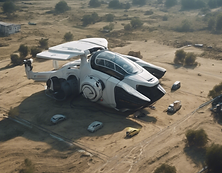
In 2050, the city was a fascinating blend of advanced technology and regenerated nature. The streets were smooth and quiet, with most vehicles being electric and autonomous. Drones flew over people's heads, delivering packages, and solar power feeds almost every building, making them independent of traditional grids. It was February 18, and the sun was setting on a world that had changed a lot in the last 25 years. In 2025, climate change had been an imminent threat and governments were just starting to take action. But since then, people have been collaborating globally more than ever. Carbon capture technologies were implemented on a large scale, and artificially planted forests helped restore the natural balance. The world was going through an energy revolution. In 2027, the first fusion nuclear power plants offering clean, cheap and almost unlimited energy were created. That was a turning point. A global decision to ban petrol and diesel cars followed, and public transport became fully electric and autonomous. What had previously been a dream – cities without traffic, clean air, and responsible consumption – had now become reality. People had more time for themselves, their families, and their education. Instead of spending hours in traffic, they were able to learn or create. Schools around the world had been transformed, with education based on practical learning and the development of critical thinking, not just on memorizing information. Another important step between 2025 and 2050 had been in personalized medicine. DNA tests and genetic therapies had helped prevent many diseases, and people's biological age had decreased. People lived longer and healthier lives, and the concept of ‘aging’ had transformed, and it was now a much slower process and much less related to physical limitations. On this day in February 2050, a 25-year-old man was walking through an urban park, surrounded by plants, trees and flowers that had perfectly integrated into the modern structures of the city. Around him, everything seemed to have found a perfect balance: Technology did not destroy nature, but protected and enriched it. He was thinking about how the future has changed thanks to the work and dedication of past generations, who have not allowed themselves to be influenced by obstacles, but have sought solutions for a sustainable future. He knew that this future would not have been possible without sacrifice. In a world where climate change threatened the entire ecosystem and where natural resources were on the verge of extinction, people had come to realize the true value of the planet. This was the vital lesson his generation had learned from the experiences of 2025-2035: how to live in harmony with the environment and how to protect what is really important. "We may have made a difference," he thought, feeling the fresh, warm air of the evening, "but we must never forget what was before." And so, in the silence of that February day, the future seemed more promising than ever.
hallo
Speranta
How I see it and how I would like it to be our future and that of our children, with peace around the world, without wars, conflicts that destabilize an entire world and make you afraid of tomorrow. More balanced young people who have a purpose in life, without drugs and all the vices of today. That the elderly know how to love life so that those in the West , are not affected by a too small pension from which they can not live, to be healthier and to have as many occupational activities as possible and for them, to make it useful.
hallo
un pessimo futuro
a better future and exploit the heat, the cold, the wind that is created in industry. is a little untapped potential even that of pollution. CO2 pollution can be transformed into positive energy, but unfortunately in 2040 it will not be possible. I see 2040 with a high rate of pollution and waste of energy, a 'reckless increase in the population that already at the beginning of the year will have consumed what the earth gives' I see more and more states wanting everything right away; rare earths electricity to go-go and if they can't get it here they threaten I see more and more a race towards weapons that use a lot of electricity we will have a world increasingly elittrized not in the sense of electricity but that given by the weather. more and more lightning in the clear sky violent cloudbursts and temperature changes Hunger is the real thing. will increase; desertification will advance quickly while the poor people will stand by waiting for something that will not come while the rich will have villas with pools and water in yosa electric motorization is useless because if every car circulating in the world were electric there would not be enough electricity and to produce it we would use polluting energies So 2040 is going to be a future like 2025 is, like 2000 was, nothing's going to change.
hallo
un monde meilleur
A world where artificial intelligence cultivates benevolence and kindness between individuals, helps to establish a climate of trust between individuals on earth. A world where hard work is taken on by technology and allows workers to return home less tired. A world where children are cherished by their parents who finally understand that children are born to be loved. A world unarmed in the proper sense of the word. A world where everyone eats their fill.
Join #OurFutures now!

The future is shaped by our ideas and our actions today. Tell us about your visions of the future and help us create a futures narrative aimed at inspiring citizens, policy-makers and foresight experts alike!

Our-futures-banner-coloured_v3.jpg

The European Commission support does not constitute endorsement of the contents which reflects the views only of the authors, and the Commission cannot be held responsible for any use which may be made of the information contained.

ERA_logo.jpg

We support the European Research Area aimed at creating a single, borderless market for research, innovation and technology in the EU.

©OurFutures 2025, All rights reserved.

  • Instagram
  • Facebook
  • LinkedIn
  • YouTube
bottom of page