top of page

Future Europe

Anonymous

March 19, 2025

Future Europe

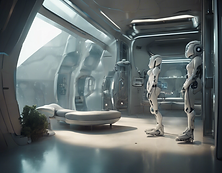
This image was generated with Dream Studio AI.

The year was 2040, and the sun rose over a Europe transformed. Cities shimmered with greenery, blending the organic with the technological in ways once thought impossible. Sofia, now 27, strolled through Berlin’s Solar Gardens, a breathtaking urban forest that stretched across the rooftops of interconnected buildings, generating energy while providing shade and food for residents below.

Sofia's day began like most: her wearable device, a lightweight bracelet, projected her itinerary into the air in front of her. It spoke to her softly, reminding her of her morning meeting with the Council of Futures, a collaborative body representing citizens across Europe that met virtually in the Metaverse—a now seamless blend of augmented reality and physical spaces. The Council was discussing new biodiversity zones, which had been expanding since the 2030s, when Europe unified its efforts to combat climate change and rewild vast stretches of land.

The decades leading up to 2050 were not without challenges. The Great Transition of the 2030s had seen Europe abandon fossil fuels entirely. It was a turbulent time, with protests, tough compromises, and ambitious policies. But it paid off. By 2040, clean energy powered every home, vehicle, and business. Small towns and cities had become self-sufficient, their local economies thriving thanks to advancements in renewable technology and vertical farming.

Education had transformed too. Sofia’s younger brother, Elias, spent his mornings learning history by exploring immersive recreations of past events. His favorite? The Unity Summit of 2035, where European leaders, activists, and youth representatives signed the Charter for a Regenerative Europe, committing to environmental, social, and technological renewal.

Today, Sofia’s task was to help finalize the design of a transcontinental wildlife corridor stretching from Portugal to Poland. This corridor would allow species to migrate freely and safely, undoing centuries of habitat fragmentation. As she walked, an autonomous tram passed by, silent and elegant, transporting passengers seamlessly across the city without a driver or delay.

Later that afternoon, Sofia joined friends in a cultural hub where artists from across Europe collaborated in shared spaces. They watched a holographic performance of a symphony written by an AI and inspired by data from the changing winds across the Alps. The performance symbolized how humanity and technology had learned to coexist—not with dominance, but in balance.

As the day came to a close, Sofia sat on a bench overlooking the River Spree, now teeming with life thanks to decades of revitalization efforts. She thought of the stories her grandparents told of the Europe of 2025—when climate anxiety loomed large, borders were sources of tension, and technology felt isolating rather than unifying. Those fears had not disappeared overnight, but step by step, Europe had chosen a different path.

Sofia watched as the sky turned a deep orange. A flock of starlings danced above her, their synchronized movements a reminder of what humanity could achieve when working together. Europe in 2040 was far from perfect, but it was hopeful, thriving, and resilient—proof that the future could be rewritten, one bold decision at a time.

related stories

hallo
Noch mehr Europa wagen
I hope that, despite all the obstacles, Europe will grow even closer together in order to overcome global challenges. Many of these challenges can only be mastered if not only purely national interests are represented, but if Europe approaches things with common goals. Defense, securing energy supplies, more social justice. I also hope that Europe manages to fight back against populism and falsehoods.
hallo
Šviesi ir melancholiška ateitis
2050. Sunrise over Rome's Old Town paints the sky a soft orange colour. The city wakes quietly, but already the whisper of electric vehicles and the light gust of wind carrying the salt of the Mediterranean can be heard. Europe has changed dramatically in the last 25 years. The climate crisis has forced countries to focus on renewable energy, and cities have become greener, with polluting cars virtually disappearing from the streets, replaced by autonomous electric cars and bicycles. Food production has also changed: vertical farms have solved product shortages and lab-grown meat has become a common choice. Today, my plans include a quick trip to Paris on the hyper-trains that now connect all Europe's major cities. The journey will take just an hour - time for a cup of coffee and a short chat with friends via hologram. Life has become more convenient, but have people become happier? That's what we're still looking for.
hallo
une vie sans guerre
Now, in 2040, I'm enjoying the sweetness of life in my senior residence. I'm 80 years old, and despite my various pathologies, medical progress has enabled me to be a "healthy patient"... 15 years ago, people of goodwill from all countries and religions decided to join forces against a common enemy: global warming. Humanity, united at last, turned its back on murderous, sterile wars. Since then, technical, ecological and medical progress has been phenomenal. This will allow me to live well for another few decades.
hallo
Lavenir de demain
Like chameleons, the homes of 2050 will often change appearance, both aesthetically and functionally (part of the home can become immersive at any time, for example). Our relationship with storage will also be different, as we will no longer see our stocks. They will be managed by robots in dedicated airlocks. Connected mirrors will save an incredible amount of time in preparation. There's also a major change concerning water: it will have completely disappeared from the rooms of the house, except as a beverage. As a result, we'll have done away with most of today's household appliances (clothes will be washed automatically, showers will be forced-air showers...). Our homes will no longer be just living spaces. They will serve as data collectors, which they will send to various universal AIs. However, the primary function of the home will remain as a space for families to share experiences and as a breathing space for its inhabitants.
Join #OurFutures now!

The future is shaped by our ideas and our actions today. Tell us about your visions of the future and help us create a futures narrative aimed at inspiring citizens, policy-makers and foresight experts alike!

Our-futures-banner-coloured_v3.jpg

The European Commission support does not constitute endorsement of the contents which reflects the views only of the authors, and the Commission cannot be held responsible for any use which may be made of the information contained.

ERA_logo.jpg

We support the European Research Area aimed at creating a single, borderless market for research, innovation and technology in the EU.

©OurFutures 2025, All rights reserved.

  • Instagram
  • Facebook
  • LinkedIn
  • YouTube
bottom of page