top of page

O Futuro da Educação em 2040

Anonymous

March 19, 2025

O Futuro da Educação em 2040

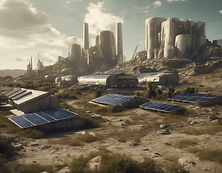
This image was generated with Dream Studio AI.

**"The Future of Education in 2040"**

In 2040, education in Europe was very different from what I knew in 2025. I was in a classroom, but it wasn't like any other conventional classroom. It was a flexible, adaptable space that adjusted to the way students learned, with walls that turned into interactive screens and tables that floated to reorganize into groups or as an individual workspace. On the opposite wall, an Albert Einstein hologram floated, explaining the theory of relativity in a fun and intuitive way. He wasn't really there, of course, but his presence was part of the new way of teaching history and science, which mixed past, present and future.

The great change that had happened over the last two decades was not only technological, but a profound transformation in the very philosophy of education. The teaching vision has been completely revised, and Europe has embraced an inclusive, holistic and student-centred model. The focus came to be not only technical and academic knowledge, but also personal and emotional development, skills that were previously neglected.

At the beginning of the journey, in 2025, schools began to change. Traditional education, centred on proofs and rigid disciplines, gave way to a project-based learning system, where students explored real and complex problems, working together with companies and organisations to find practical solutions. Schools were no longer just places of education but community centers, where families, teachers and students shared responsibilities and ideas.

In 2030, the European Union implemented a common project to ensure that all young people have access to quality education, regardless of their social or geographical context. This meant that rural areas, often neglected, began to benefit from cutting-edge educational resources, with highly interactive and personalized distance learning platforms, as well as access to mentors and global experts. The result was a generation of young people who were more informed, empathetic and better prepared to face the challenges of the future.

Now, in 2040, education was an ongoing process, without barriers of age or social status. I, now a professional in full development, continued to learn and grow. Courses and programs offered by universities and knowledge centers were available to everyone, adapted to the individual needs and pace of each person. It was a system where learning did not end with graduation, but continued throughout life, allowing anyone, regardless of their initial background, to requalify and thrive in new areas.

The integration of artificial intelligence (AI) technologies with education was one of the biggest advances. AI not only helped in teaching subjects such as mathematics, physics or history, but also in developing socio-emotional skills. They were powerful tools for teaching empathy, collaboration and ethics, essential aspects for a more just and conscious society. AI also helped teachers personalize teaching, creating unique learning paths for each student, rather than a one-size-fits-all approach.

Communities have also benefited from this change. Education has come to be seen as a collective good. Organizations and citizens were more involved in the educational process, creating localized learning networks that promoted collaboration between generations and cultures. Workshops, craft courses, entrepreneurship and sustainability were within everyone's reach, allowing each person to find their passion and purpose.

The future of education in 2040 was thus the true democratization of knowledge. A future where equality of opportunity was not just an ideal, but a lived reality. And all this was possible because society, Europe as a whole, understood that education is the basis for any positive transformation. The change was underway, and the horizon was more promising than ever.

related stories

hallo
Den gröna framtiden
I would like to see a future where there has been a major change for the benefit of the environment and the future of the planet. Solar, wind and hydropower have replaced fossil energy sources. Buildings, houses, etc. are equipped to be self-sufficient both in terms of energy and, for example, basic raw materials such as potatoes and the like. Public transport has switched entirely to electric vehicles and there are incredible high-speed trains that can compete with flights between major cities.
hallo
Naturen er reddet
You have invented a technology that effectively breaks down CO2 from the atmosphere and you are back to a world without climate change. The gardens are healthy with beautiful coral reefs and full of fish. In the North there is winter with long periods of snow. Farther south in Europe there are rarer forest fires and normal amounts of rain that give good breeding. There are no climate refugees. They appreciate nature more and seek it out often. Animal welfare is also an important focus area and you eat less meat. Smartphones and computers are used less often, and you are less accessible by phone/mail both privately and at work.
hallo
Podróże w czasie
In 2040, the world looked very different than it did twenty years ago. Poland has become a peaceful, safe and united country around common values. The streets were clean, the cities well organized, and people lived in harmony, valuing their traditions and culture. There was an atmosphere of tranquility in the towns, with children playing in the backyards without fear, the elderly walking in the parks, and the neighbours knowing each other and helping each other in their daily lives. Local communities thrived and small family businesses thrived, supported by modern technologies and a conscious approach to the economy. There were no problems with crime or riots. The authorities have made sure that the country develops in a sustainable and safe way. Young people had good prospects – they could educate themselves at a high level, develop their passions and be sure that they would find a decent job. Thanks to a wise economic policy, Poland became self-sufficient – agriculture flourished, domestic companies produced modern technologies, and people enjoyed stability and prosperity. Society was united, proud of its history and ready to build the future in accordance with its own values. In the evening, sitting on the terrace of his house, John looked at the quiet streets and felt gratitude. He knew that his children were growing up in a world where they could feel safe, respect their roots and build a better future for generations to come.
hallo
Aucun
Au réveil, les machines préparent le petit déjeuner que j'ai l'habitude de prendre (café, pain grillé et un fruit). Mes vêtements sont prêts et se mettent automatiquement sur moi. Je prends des transports en commun qui vont vite, vole et permettent d'arriver rapidement sur son lieu de travail. Ce n'est pas très durable mais c'est pratique. Le vélo est devenu une activité en perte de vitesse car c'est moins rapide. La société va toujours plus vite. Tout est informatisé et ne permet pas d'avoir trop d'interaction sociale et c'est un bat qui blesse. Pour la vie de famille, cela reste tous ensemble dans la même maison mais cela ne permet pas vraiment de se croire en famille car chacun est plus isolé devant un appareil électrique qui occupe son temps libre
Join #OurFutures now!

The future is shaped by our ideas and our actions today. Tell us about your visions of the future and help us create a futures narrative aimed at inspiring citizens, policy-makers and foresight experts alike!

OURfutures.png

The European Commission support does not constitute endorsement of the contents which reflects the views only of the authors, and the Commission cannot be held responsible for any use which may be made of the information contained.

ERA_logo.jpg

We support the European Research Area aimed at creating a single, borderless market for research, innovation and technology in the EU.

©OurFutures 2025, All rights reserved.

  • Instagram
  • Facebook
  • LinkedIn
  • YouTube
bottom of page