Old x New Europe

Anonymous
March 19, 2025

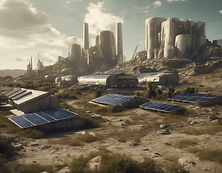
This image was generated with Dream Studio AI.
A Day in 2050: A New Dawn for Europe
The sun rose over the horizon, its rays glistening off the shimmering glass and greenery that had taken over Europe’s once-industrial skyline. It was 2050, and the continent had transformed in ways unimaginable just 25 years ago. Today, as I step outside my apartment in the heart of Paris, the first thing I notice is the air—crisp, clean, and full of vitality. The smog of the 2020s, a constant companion in the major cities, had long been banished by the global shift towards renewable energy. Solar panels, wind farms, and vertical forests were now commonplace in every city, with technology woven into the very fabric of daily life.
As I hop onto my self-driving, electric bike, I pass by a newly built pedestrian hub that had once been a major highway, now repurposed as green space. The streets are quieter, save for the hum of electric transport, and I can hear birds chirping in what used to be a densely polluted area. People stroll, chat, and share the space with the occasional robot delivering groceries, parcels, or even meals, thanks to Europe’s seamless integration of AI and robotics into daily tasks.
Europe’s transformation began in 2025, when the Green Deal accelerated the region’s commitment to carbon neutrality. The EU, which had always been a hub of political innovation, implemented bold policies that put sustainability at the forefront of every decision. By 2030, most of Europe had already abandoned fossil fuels. Public transport was electrified, and solar and wind energy powered the majority of homes. From local farms to big cities, there was a collective effort to decentralize energy production, making each community self-sufficient in clean power.
In 2035, the big shift came. Artificial Intelligence, powered by advancements in quantum computing, reached a level of sophistication that made many traditional jobs obsolete. While the transition was difficult for some, the European Union implemented universal basic income (UBI) and retraining programs, allowing people to find new purpose in a world no longer reliant on routine labor. People had more time for creativity, research, and personal growth. In this new society, work wasn’t the primary source of identity—it was just one aspect of life, if that.
By 2040, Europe had created a pan-continental network of smart cities. From Stockholm to Lisbon, every city had become an interconnected organism where transportation, energy, education, and healthcare were all managed by an intelligent grid. If you needed to travel, an autonomous vehicle would pick you up, and you could focus on reading, working, or simply relaxing. Health care had become preventative—personalized medicine using AI would monitor everyone’s health, making sure that no one ever fell through the cracks.
The workforce had become more diversified, with many people focusing on arts, education, and innovative projects that focused on humanity’s connection to nature. The rising importance of biodiversity preservation meant that green spaces flourished, and society truly began to value the environment—not just as a resource to be exploited, but as an essential part of what it meant to be human.
Looking out over the Seine this morning, I think about how different life was just a few decades ago. There were protests, fear about climate change, and the social unrest that stemmed from inequality. But in this new Europe, collaboration had become the cornerstone of progress. The past had been a difficult journey, but it was worth it.
Now, as I make my way through a park, I see children playing with advanced technology, yet they seem free from the burdens of competition that defined previous generations. They communicate effortlessly in multiple languages, thanks to AI-powered translation devices that had been perfected by 2035. The walls of national identity had faded, and Europe had embraced its rich mosaic of cultures as an interconnected whole.
As I reach the futuristic yet ancient café by the river, I smile. I think about the future ahead. It’s a future that is no longer just about surviving—it’s about thriving, together.
related stories