top of page

transports collectifs

Anonymous

March 19, 2025
transports collectifs

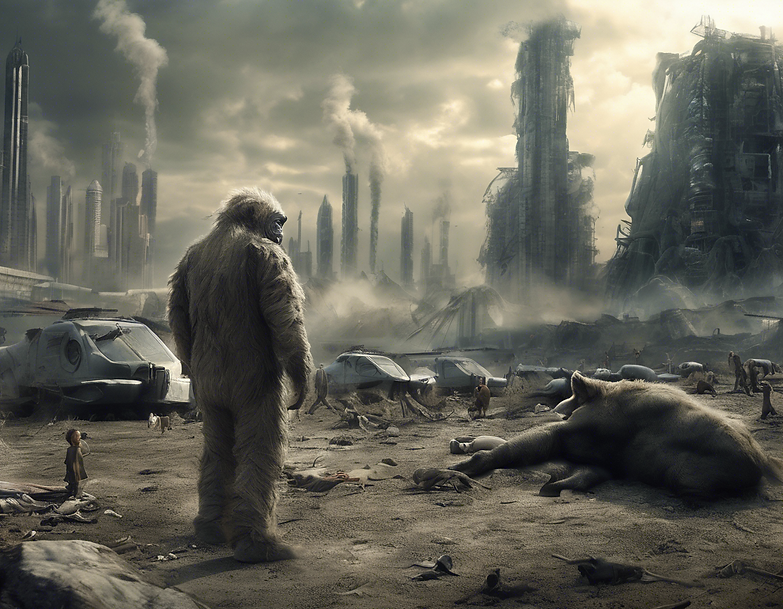
This image was generated with Dream Studio AI.

In 2040, if I'm still alive, I'll be almost 90. But, given my average health, I'll surely be dead, as will many other animals and humans, given current pollution and climate degradation, if it weren't for the murderous and warlike madness of the so-called humans who outbid us.
But if we give up our egoism, in particular by abandoning individual means of transport such as the fossil-powered car or the all-too-easy airplane, we could develop numerous modes of public transport - trains, streetcars, buses and coaches - and recreate a dense enough network to encourage useful or leisure travel, as well as favoring transport by boat instead of airplane.
All this can be developed by collectivizing the means to produce them.
One of my grandmothers, almost 111, could still jokingly say: "I've lived through 3 centuries, the 19th, 20th and 21st", because she lived a healthy life, almost self-sufficiently with her husband, wounded in the 1914-18 war.
On the other hand, at the age of 10, between the years 1900 and 1910, she remembered being amazed by her first automobile trip when a wealthy neighbor drove her 2 kilometers from school to home. At the same time, the students took turns carrying a log of wood in their bags to heat the school in winter. She would surely be sorry to know that today this "Wonder" has contributed to the destruction of the Earth. Or to learn, as I did, belatedly that the American industrialists of the early days of the automobile bought up public means of transport, only to abandon and destroy them immediately to develop their own financially juicy industries, and that the Europeans followed suit.
My father, born in 1920, could still take 2 or 3 local trains or streetcars as a child, with connections, to travel 40 kilometers from Dunois to Perche-Gouët".
We can recreate this spirit, this frugality and good living, even this joy of public transport.

related stories

hallo
Devillersrolandhubert@gmail.com
Hello everyone, thank you very much for this innitiative, I imagine rightly or wrongly that a certain number of problems can be solved As for example one of my projects is 1) equipment to effectively fight forest fires 2) marketed equipment neutralising the aquaplanig of vehicles But for lack of start-up aid my two projects are still waiting for my fault without a doubt and this day almost 79 years I ask myself questions ???,well thank you Signed, devillersrolandhubert@gmail.com
hallo
Lavorare meno, lavorare tutti
Whatever we do to improve the world is not enough if we spend as much as 8 hours a day working. Waiting for the weekend to live is barbaric in 2024. We should work 4 hours a day with an adequate salary and we all know that part-time work exists but it must be implored and those who want to work 4 hours earning less are considered lazy.
hallo
Αμφιλεγόμενο
paraskeuaidis.nicolas@gmail.com
hallo
gittevandegraveele@gmail.com
By 2040, I would like the way we deal with food and public space to have fundamentally changed. An ideal image I have in mind, based on the projects I am working on, such as Fruitstraat Gent, is that cities have been completely transformed into green, edible landscapes. In this future, cities are not only functional living spaces, but also productive ecosystems where fruit trees, vegetables and herbs grow lushly in streets, squares and parks. Everyone has access to healthy and local food thanks to the myriad of commons such as communal gardens and fruit trees, where residents have free access to pick. The idea of a short and sustainable food chain is fully embedded in urban life: people harvest their own food or buy it directly from neighborhood cooperatives, without the intervention of polluting, long distribution chains. In addition, there is a broad awareness of the importance of community and participation. Speculative design projects are no longer just a niche, but have been given a central role in shaping urban development. Residents are actively involved in designing the future of their city, with participation and engagement at the heart of policy decisions. Each district has its own projects and experiments that constantly contribute to the improvement of the living environment, both socially, economically and ecologically. This vision of the future would result in a healthier, cohesive and more resilient society in which people not only have a connection with each other, but also with nature and the food they consume.
Join #OurFutures now!

The future is shaped by our ideas and our actions today. Tell us about your visions of the future and help us create a futures narrative aimed at inspiring citizens, policy-makers and foresight experts alike!

OURfutures.png

The European Commission support does not constitute endorsement of the contents which reflects the views only of the authors, and the Commission cannot be held responsible for any use which may be made of the information contained.

ERA_logo.jpg

We support the European Research Area aimed at creating a single, borderless market for research, innovation and technology in the EU.

©OurFutures 2025, All rights reserved.

  • Instagram
  • Facebook
  • LinkedIn
  • YouTube
bottom of page